> ## Documentation Index
> Fetch the complete documentation index at: https://docs.pixldata.com/llms.txt
> Use this file to discover all available pages before exploring further.
# Text Annotation Module
> Label text in PixlHub: entity spans by highlighting, class hotkeys, the entities panel with character offsets, and flexible TXT, CSV and spreadsheet imports.
Text projects open a different editor: no canvas, no boxes, just your document and a highlighter that understands classes. Named entity recognition, span extraction and text classification data all come out of the same motion: select text, and it becomes a labeled span.
Create a project with the **Text** tool type to get this editor. Text projects accept **TXT, CSV, TSV, MD and XLSX** uploads, with an import mode choice that matters: **each row = task** (a CSV of examples becomes a queue) or **each file = task**.
## The editor
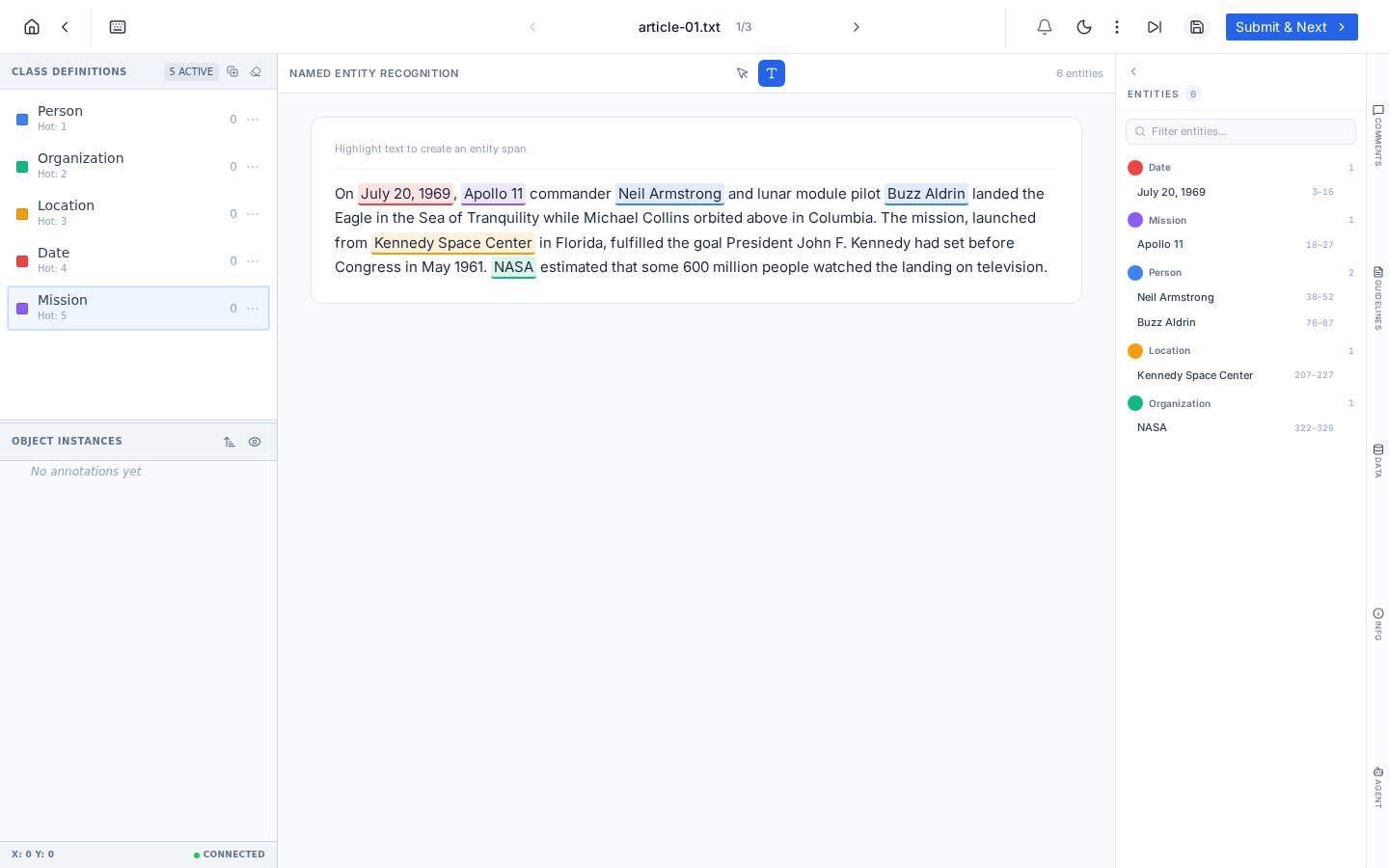 The layout mirrors the image editor where it can: [class definitions](/guides/basics/class-definitions) with hotkeys top-left, the right rail with Comments, Guidelines, Dataset, Info and Agent, and the same Submit and save actions in the header. The center is the document, rendered clean and readable.
## Label a span
Press the class hotkey (1 through 5) or click the class: Person, Organization, whatever your schema defines.
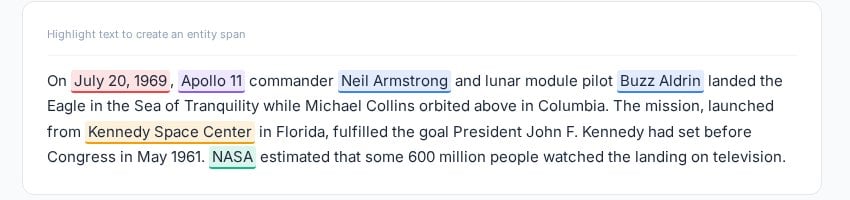
Select the words with your cursor, exactly like selecting text anywhere. On release, the span takes the armed class and renders inline with its color.
The entity counter at the top right tracks progress; Submit & Next sends the task to review like any other.
The layout mirrors the image editor where it can: [class definitions](/guides/basics/class-definitions) with hotkeys top-left, the right rail with Comments, Guidelines, Dataset, Info and Agent, and the same Submit and save actions in the header. The center is the document, rendered clean and readable.
## Label a span
Press the class hotkey (1 through 5) or click the class: Person, Organization, whatever your schema defines.
Select the words with your cursor, exactly like selecting text anywhere. On release, the span takes the armed class and renders inline with its color.
The entity counter at the top right tracks progress; Submit & Next sends the task to review like any other.
 ## The Entities panel
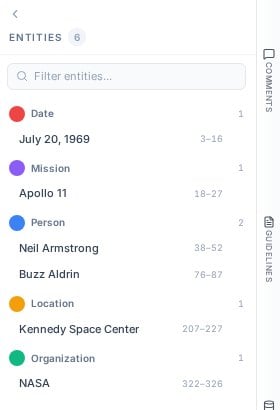
Every span lists on the right, grouped by class, with its **exact character offsets** (like 38–52). Offsets are the ground truth NER training expects, and having them visible makes disputes precise: a reviewer can say "the Person span at 38–52 clips the surname" instead of describing a highlight.
## The Entities panel
Every span lists on the right, grouped by class, with its **exact character offsets** (like 38–52). Offsets are the ground truth NER training expects, and having them visible makes disputes precise: a reviewer can say "the Person span at 38–52 clips the surname" instead of describing a highlight.
 ## Working notes
* **Punctuation discipline.** Decide in your [Guidelines](/guides/basics/guidelines) whether spans include trailing punctuation and honor it; offset-level consistency is what NER models learn from.
* **Overlaps and nesting** are schema decisions: "Kennedy Space Center" as one Location or "Kennedy" as a Person inside it is a policy, not a preference.
* **CSV row mode scales.** A thousand-row CSV becomes a thousand-task queue in one upload, with the workflow, review and metrics machinery working as usual.
* **Agents fit naturally here.** A configured [NER agent](/guides/ai/agents) can propose spans that humans verify, the text counterpart of model pre-labeling.
## Frequently asked questions
Select it and press the correct class hotkey to reclassify, or delete it and re-highlight. Edits are undoable like everything else.
Spans export with class and character offsets, ready for standard NER training formats. See Exports.
The Text tool type covers classification-style projects too; the schema defines the classes, and the task-per-row import makes labeled example sets fast to produce.
## Next steps
LLM pre-labeling for text tasks.
Bringing existing text datasets in.
## Working notes
* **Punctuation discipline.** Decide in your [Guidelines](/guides/basics/guidelines) whether spans include trailing punctuation and honor it; offset-level consistency is what NER models learn from.
* **Overlaps and nesting** are schema decisions: "Kennedy Space Center" as one Location or "Kennedy" as a Person inside it is a policy, not a preference.
* **CSV row mode scales.** A thousand-row CSV becomes a thousand-task queue in one upload, with the workflow, review and metrics machinery working as usual.
* **Agents fit naturally here.** A configured [NER agent](/guides/ai/agents) can propose spans that humans verify, the text counterpart of model pre-labeling.
## Frequently asked questions
Select it and press the correct class hotkey to reclassify, or delete it and re-highlight. Edits are undoable like everything else.
Spans export with class and character offsets, ready for standard NER training formats. See Exports.
The Text tool type covers classification-style projects too; the schema defines the classes, and the task-per-row import makes labeled example sets fast to produce.
## Next steps
LLM pre-labeling for text tasks.
Bringing existing text datasets in.