> ## Documentation Index
> Fetch the complete documentation index at: https://docs.pixldata.com/llms.txt
> Use this file to discover all available pages before exploring further.
# Tasks
Tasks are the operational units of PixlHub. While **Assets** represent the raw data, **Tasks** represent that data within a workflow, assigned to specific users and tracked through various stages of the labeling lifecycle.
### **Task Management & Metrics**
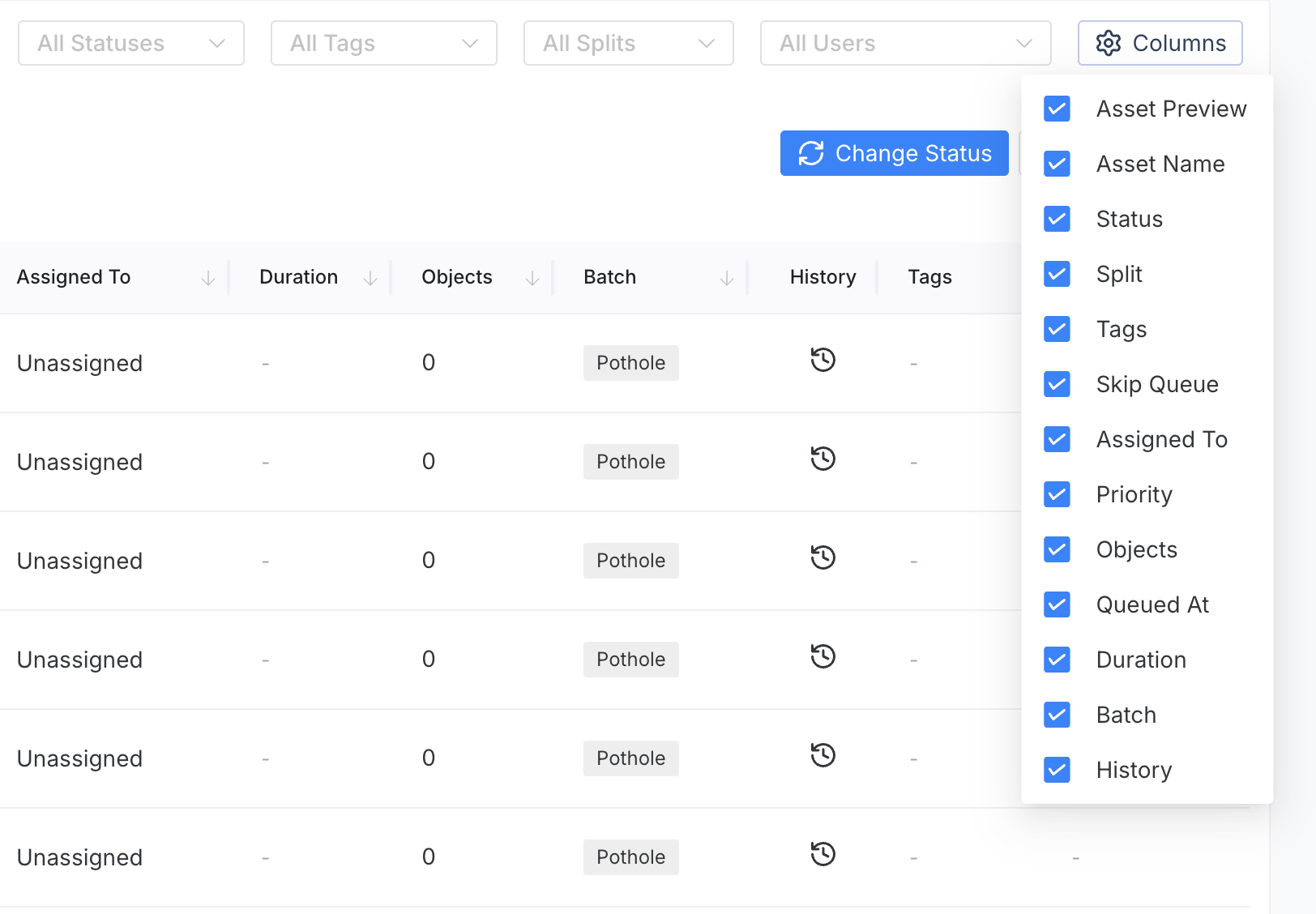
The Tasks page provides a high-level overview of project progress through a detailed data table. Each entry allows managers to monitor the health and velocity of the project using the following metrics:
* **Status:** The current stage of the task (e.g., Prepare, Label, Review, Completed).
* **Assignee:** The specific user currently responsible for the task.
* **Duration:** The active time spent by annotators on the task.
* **Object Count:** The total number of annotations/objects created within the task.
* **Split:** The dataset category (Train, Validation, or Test) assigned to the task.
* **Task History:** A chronological log of every action, status change, and user interaction.
* **Operational Tags:** Visibility into priority levels, batch assignments, "skipped" status, and the exact time the task entered the queue.
 ### **Bulk Operations**
To manage large-scale datasets efficiently, PixlHub allows for administrative actions to be performed on multiple selected tasks simultaneously.
#### **1. Change Status**
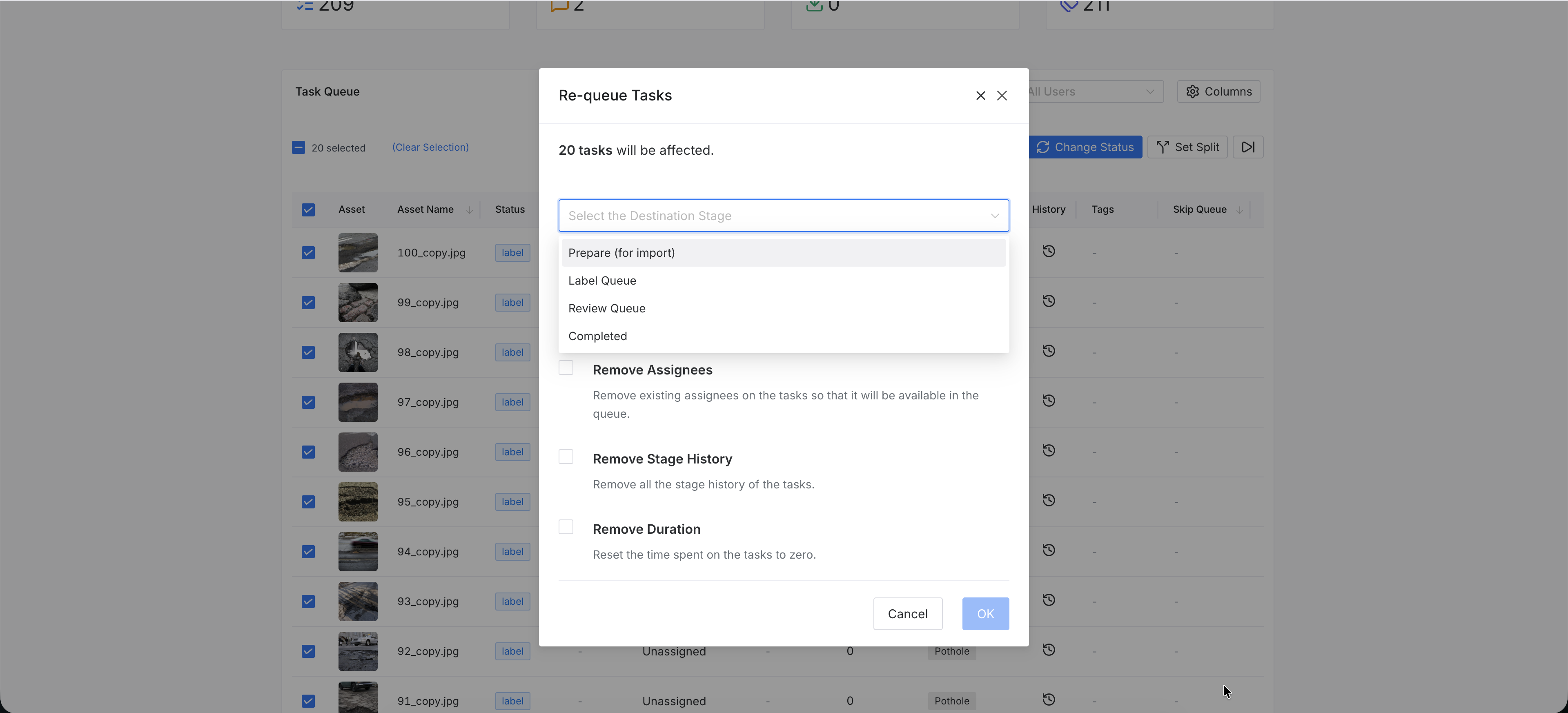
This core operation moves tasks between different stages of the workflow. When changing status, managers can also perform "cleanup" actions via a modal window:
* **Remove Annotations:** Wipes all existing labels so annotators can start from scratch.
* **Remove Assignees:** Unassigns users, returning the tasks to the general pool/queue.
* **Remove Stage History:** Deletes the chronological record of the task's journey.
* **Remove Duration:** Resets the "time spent" metric to zero.
### **Bulk Operations**
To manage large-scale datasets efficiently, PixlHub allows for administrative actions to be performed on multiple selected tasks simultaneously.
#### **1. Change Status**
This core operation moves tasks between different stages of the workflow. When changing status, managers can also perform "cleanup" actions via a modal window:
* **Remove Annotations:** Wipes all existing labels so annotators can start from scratch.
* **Remove Assignees:** Unassigns users, returning the tasks to the general pool/queue.
* **Remove Stage History:** Deletes the chronological record of the task's journey.
* **Remove Duration:** Resets the "time spent" metric to zero.
 #### **2. Set Split**
This function organizes data for machine learning workflows. Tasks can be assigned manually or via **Auto Split** into three standard categories:
* **Train:** Data used for model training.
* **Validation:** Data used for hyperparameter tuning and progress monitoring.
* **Test:** Independent data used for the final model evaluation.
#### **2. Set Split**
This function organizes data for machine learning workflows. Tasks can be assigned manually or via **Auto Split** into three standard categories:
* **Train:** Data used for model training.
* **Validation:** Data used for hyperparameter tuning and progress monitoring.
* **Test:** Independent data used for the final model evaluation.
 #### **3. Clear Skip**
If an annotator "skips" a task due to ambiguity or poor image quality, it is removed from the active queue. The **Clear Skip** operation resets this status, allowing the task to be re-evaluated or re-labeled.
#### **3. Clear Skip**
If an annotator "skips" a task due to ambiguity or poor image quality, it is removed from the active queue. The **Clear Skip** operation resets this status, allowing the task to be re-evaluated or re-labeled.